

Oppositional Defiant Disorder (ODD) Therapy for Children and Teens in Florida

Is every day a battle? Constant arguing, defiance, anger outbursts, or refusal to follow rules are exhausting for an entire family, and they are rarely just a phase. These patterns are often signs of Oppositional Defiant Disorder (ODD). At It Begins Within, our specialists provide evidence-based ODD therapy for children, teenagers, and families across Tampa, St. Petersburg, and Sarasota, plus telehealth throughout Florida. We help families break the cycle of defiance and rebuild healthy, connected relationships at home.
What Is Oppositional Defiant Disorder (ODD)?
Oppositional Defiant Disorder is a behavioral condition, typically diagnosed in children and teens, defined by a persistent pattern of angry or irritable mood, argumentative and defiant behavior, and vindictiveness. To meet criteria, the pattern lasts at least 6 months and causes meaningful problems at home, school, or with peers.
The behavior generally occurs with someone who is not a sibling and includes several symptoms across the following categories:
Angry or irritable mood. Frequently loses temper, is easily annoyed, and is often angry or resentful.
Argumentative or defiant behavior. Argues with authority figures, refuses to follow rules, deliberately annoys others, and blames others for mistakes.
Vindictiveness. Has been spiteful or vindictive on repeated occasions.
When Is Defiance More Than a Phase?
Every child pushes back sometimes. Testing limits, occasional tantrums, and the word "no" are all a normal part of development. The difference with ODD is in the intensity, the frequency, and the impact. Ordinary defiance comes and goes. ODD is a pattern that persists for months and begins to damage a child's relationships, learning, and daily functioning.
It may be time to reach out to a specialist when you notice:
Defiance and anger that show up most days rather than occasionally.
Outbursts that feel out of proportion to the situation.
Conflict that is straining the parent-child relationship or the whole household.
Trouble at school, with teachers, or with friendships tied to the behavior.
A sense that consequences and rewards you have tried are no longer working.
If your child's behavior includes safety concerns, aggression that puts anyone at risk, or talk of self-harm, contact a licensed professional or emergency services right away rather than waiting for a scheduled consultation.
Our ODD Specialists in Tampa, St. Petersburg, and Sarasota

Brianna Garcia, LMHC
Child and teen therapist in Tampa specializing in behavioral challenges, emotional regulation, and ADHD.


Genevieve Savage, LCSW
Child and teen therapist in St. Petersburg specializing in ODD, defiant behaviors, and art and play therapy.
Nicole Young, LCSW
Child and teen therapist in Sarasota specializing in behavioral challenges and defiance for ages five to seventeen.

Samantha Wilson, LMHC
Child and teen therapist in Sarasota specializing in trauma, anxiety, and emotional regulation.
How ODD Is Evaluated at Home, School, and in Therapy
A thoughtful evaluation looks at your child across every setting, because ODD can look different at home than it does in the classroom. A licensed mental health professional gathers information from several sources to understand the full picture rather than relying on any single moment or report.
At Home
Parents and caregivers share what daily life looks like, including triggers, routines, what tends to escalate a situation, and what helps a child settle. This history is one of the most valuable parts of the process, because you see your child in the moments a clinician never will.

At School
With your permission, teacher input and school observations help clarify whether behaviors appear in structured settings, how they affect learning, and how your child relates to peers and authority figures outside the home.

In Therapy
During clinical sessions, your therapist observes your child directly, builds rapport, and uses structured interviews and behavioral observation to understand what is driving the behavior. A formal diagnosis and treatment plan come from a qualified mental health professional. If comprehensive psychological testing is appropriate, that specialized assessment is conducted by our licensed psychologist. Learn more about our child therapy services.

When a Comprehensive Psychological Evaluation Helps
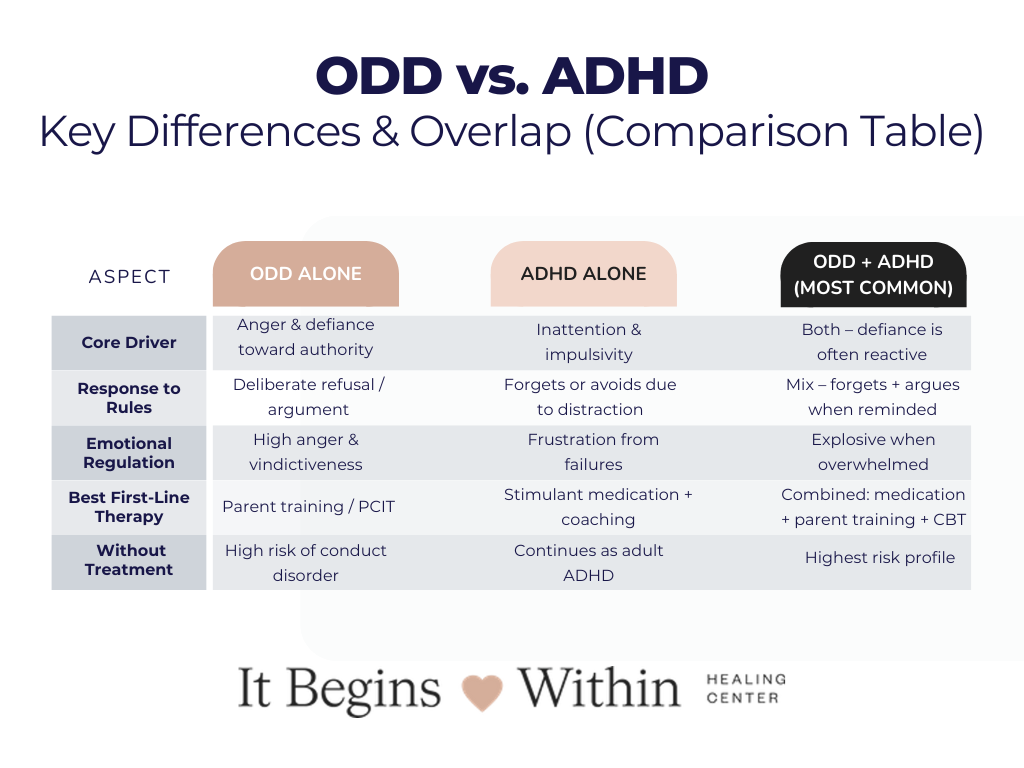
Sometimes defiant behavior overlaps with other concerns such as ADHD, a learning difference, autism, or anxiety, and it can be difficult to tell what is driving what. In those cases, a comprehensive psychological evaluation brings clarity. At It Begins Within, formal psychological testing and evaluation are conducted by Dr. Christine Pickering, a Licensed Psychologist, Board Certified Behavior Analyst, and Nationally Certified School Psychologist. A thorough assessment can distinguish ODD from overlapping conditions, clarify diagnosis, and guide a treatment plan that targets the real underlying needs, and it can also support school accommodations through 504 or IEP documentation when appropriate.

ODD vs. ADHD: Key Differences & Overlap
How ODD Looks at Different Ages
Younger Children
Younger children often show defiance most strongly at home while managing to hold it together at school. Meltdowns, refusing chores, blaming siblings, and explosive anger are common. Early intervention through parent-focused approaches tends to produce the best outcomes at this stage.
Adolescents
In the teen years, ODD can look like more than an ordinary defiant teenager. It may include skipping school, running away, substance use, or verbal aggression. Without support, the risk of related concerns such as conduct difficulties or depression rises. Structured cognitive behavioral therapy has been shown to help teens meaningfully improve.
Adults
Adult ODD is often under-recognized because it gets mislabeled as a "difficult personality." Approaches such as CBT, anger management, and schema-focused work can be highly effective for adults who recognize these patterns in themselves.
What Causes ODD?
ODD does not have a single cause. It usually develops from a combination of factors:
Genetic and biological. Family history of mental health conditions and differences in brain chemistry.
Environmental. Inconsistent expectations, stress, trauma, or a high-conflict household.
Developmental. Co-occurring conditions such as ADHD or a learning difference.
At It Begins Within, we never assign blame. We focus on understanding your child's unique circumstances and building a plan that fits your family.
Parent Training for Oppositional Defiant Disorder
Parent training is one of the most effective, research-supported approaches to ODD, especially for younger children. The premise is simple and powerful: you are with your child far more than any therapist ever will be, so equipping you with the right skills multiplies every hour of treatment.
In parent-focused work, you learn to:
Respond to defiance in a way that de-escalates rather than fuels a power struggle.
Set clear, consistent limits that your child can predict and rely on.
Reinforce the behaviors you want to see more often through structured attention and praise.
Strengthen the parent-child relationship so cooperation grows out of connection, not control.
For families with children roughly ages three to ten, our Child-Parent Relationship Therapy program teaches you the same play-based skills our clinicians use in session. You can also explore our broader behavioral therapy for children, which focuses on building practical regulation and cooperation skills.
What Parents Should Avoid When ODD Behaviors Escalate
When defiance escalates, the instinct to push back harder is completely understandable. Yet a few common responses tend to intensify the cycle rather than calm it. Knowing what to step away from is often as important as knowing what to do.
Meeting escalation with escalation. Raising your voice or matching a child's intensity usually adds fuel rather than resolution.
Shifting rules in the heat of the moment. Inconsistent limits make behavior less predictable, not more manageable.
Engaging every argument. Being drawn into repeated power struggles can reinforce the very pattern you want to reduce.
Waiting it out indefinitely. Hoping a child will simply grow out of persistent defiance often allows patterns to become more entrenched over time.
None of this means a parent is doing something wrong. These are hard, human moments, and a specialist can help you replace reactive cycles with steady, effective strategies that fit your family.
ODD Therapy in Tampa
Located in Westshore, our team offers child therapy in Tampa for families throughout Hillsborough County, including Hyde Park, Carrollwood, Brandon, Riverview, and Apollo Beach. We provide structured parent coaching, specialized child therapy, and family counseling to address oppositional behavior, strengthen communication, and restore harmony at home.

ODD Therapy in St. Petersburg
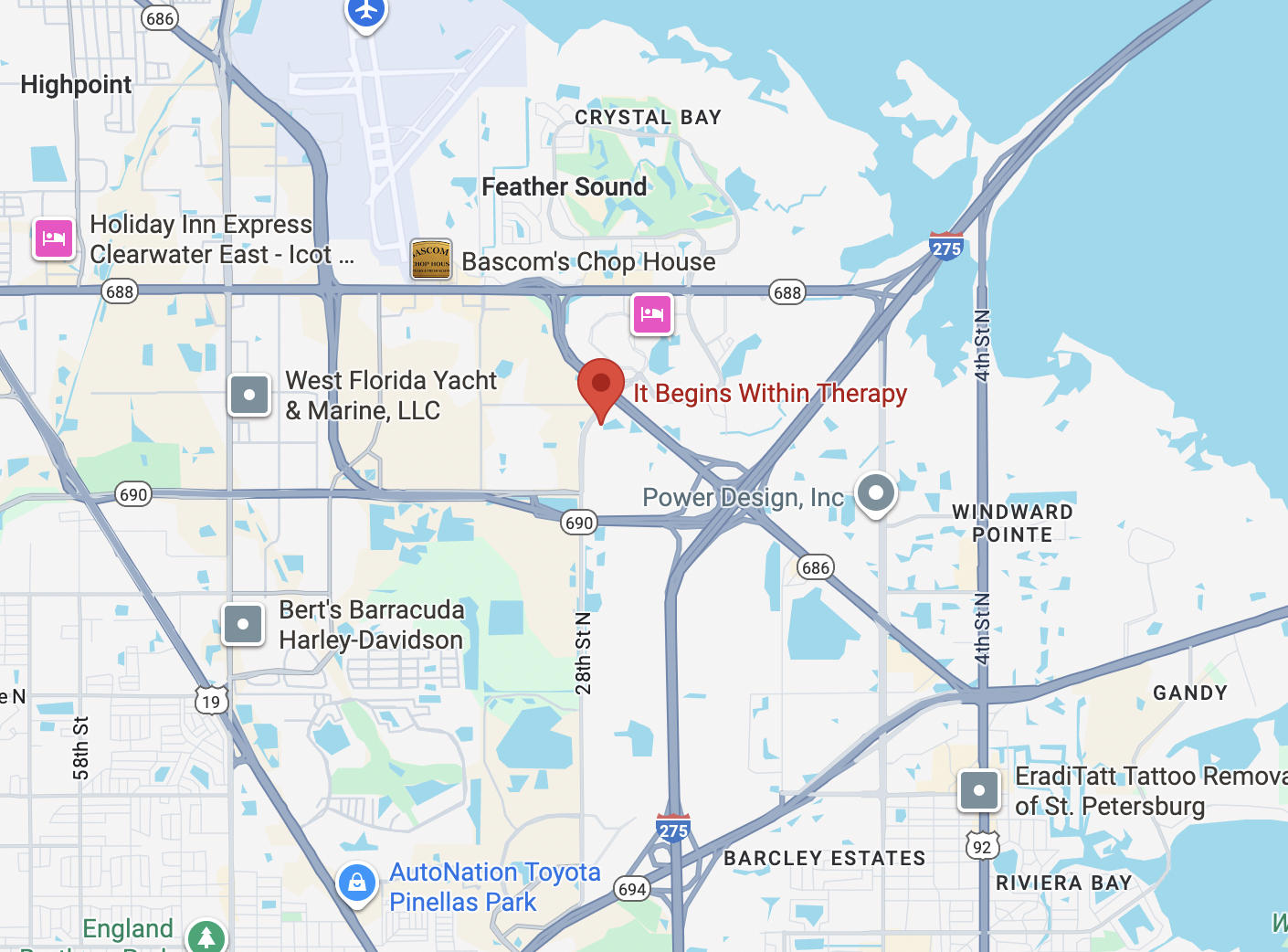
Our team provides child therapy in St. Petersburg for children, teens, and families throughout Pinellas County, including Clearwater, Largo, Gulfport, Seminole, Feather Sound, and Treasure Island. Our licensed therapists combine parent coaching, child therapy, and family work to reduce defiant behavior, improve communication, and build calmer daily routines.
ODD Therapy in Sarasota
Our team offers child therapy in Sarasota for children and teens across the Suncoast region, including Lakewood Ranch, Bradenton, Venice, Siesta Key, and Palmer Ranch. Our licensed therapists work closely with parents and families to reduce oppositional behavior, improve communication, and create calmer home routines using evidence-based approaches like CBT, PCIT, and family therapy.

Frequently Asked Questions About Oppositional Defiant Disorder (ODD) Therapy
How do I know if my child's defiance is normal or ODD?
Occasional defiance is a normal part of growing up. ODD is different because the pattern is persistent, lasting at least six months, and it causes real problems at home, at school, or with friends. If anger and defiance show up most days, feel out of proportion, and are straining your family or your child's functioning, a professional evaluation can bring clarity.
Can ODD symptoms appear only at home and not at school?
Yes. This is very common, especially in younger children, who may hold it together in structured settings like school and then release that tension at home where they feel safest. Behavior that shows up primarily at home is still worth taking seriously, and a good evaluation gathers information from multiple settings to understand the full picture.
Can ODD affect school performance and classroom behavior?
It can. Ongoing conflict with teachers, difficulty following classroom rules, and strained peer relationships can interfere with learning and participation. Addressing ODD often improves not only behavior but also a child's ability to engage and succeed at school. You may also find our guide on school refusal helpful if avoidance of school is part of the picture.
Should teachers be involved in ODD treatment?
When appropriate and with your permission, teacher input is valuable. Teachers see your child in a structured environment among peers, and their observations help clarify how behaviors present outside the home. Coordinated support across home, school, and therapy tends to produce stronger, more consistent results.
Can online therapy help with ODD parent coaching?
Yes. Parent coaching translates especially well to telehealth, because much of the work centers on the skills and strategies you practice with your child at home. Through secure video sessions, your therapist can guide you, troubleshoot real situations, and support your progress from anywhere in Florida.

Oppositional Defiant Disorder Treatments Near Me
Our licensed therapists provide ODD therapy in Tampa, St. Petersburg, and Sarasota—helping children, teens, and families reduce conflict, build healthier routines, and strengthen relationships.